


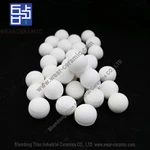
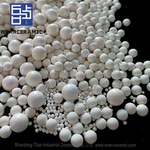
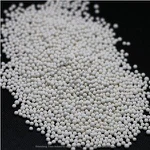


Inert Alumina Ceramic Balls As Grinding Media
Product Code: BMYM92, BMYM95
Product Material: Alumina ceramic
Product Size: 0.5-90mm
Product Color: White
Certifified: ISO 9001
Customized: Availiable
Product Introduction
TITAN Inert Alumina Ceramic Balls are engineered for grinding systems that require stable milling, controlled wear, and reliable ceramic performance. Available in multiple sizes and alumina grades, they support efficient particle reduction while helping limit media contamination in mineral, ceramic, chemical, and other industrial powder-processing applications.
Why Use Alumina Ceramic Media for Grinding?
Grinding efficiency depends not only on the mill itself but also on how effectively the media transfers mechanical energy to the feed material.
During operation, grinding balls are continuously exposed to impact and friction. If the media wear too quickly, their diameter changes, grinding conditions become less consistent, and additional media must be added more frequently. Excessive wear can also introduce unwanted material into the processed powder.
Alumina ceramic provides a practical combination of hardness, density, wear resistance, and chemical stability. These characteristics make it suitable for applications where stable grinding performance and controlled media consumption are important.
High Wear Resistance for Longer Operating Cycles
TITAN forms the ceramic body through controlled shaping and high-temperature sintering. This creates a dense structure designed to withstand repeated mechanical contact during milling.
For the buyer, the advantage is not simply a harder grinding ball. Better resistance to surface wear helps maintain the working geometry of the media and can reduce the frequency of replenishment.
This is particularly valuable in continuous production, where frequent media replacement can increase labor requirements and interrupt normal operation.
Different Sizes for Different Grinding Requirements

There is no single grinding ball size that is suitable for every application.
Larger media can provide stronger impact for relatively coarse feed, while smaller media provide a greater number of contact points and can be considered for finer grinding or dispersion.
TITAN's range covers approximately 0.5–90 mm, allowing buyers to select the media diameter according to feed size, target fineness, mill type, and operating conditions.
When selecting a size, buyers should consider:
Feed particle size
Required final particle size
Mill type
Milling speed
Material hardness
Wet or dry grinding
Slurry concentration
Required production capacity
How to Choose the Right Alumina Grinding Ball?
Choosing grinding media only by price can result in higher long-term operating costs. A better approach is to evaluate the complete grinding requirement.
1. Match the Media to the Feed Size
If the incoming material is relatively coarse, larger media may be required to generate sufficient impact energy.
For finer feed or final-stage milling, smaller media can provide more contact points and improve the efficiency of fine particle reduction.
2. Consider the Required Fineness
The target particle size is one of the most important parameters when selecting media.
For example, a process requiring only moderate particle reduction may not benefit from very small media. Conversely, using oversized balls in a fine-grinding process can limit the number of effective contacts.
The correct combination should be determined according to the mill and material rather than following a universal size recommendation.
3. Evaluate Alumina Grade
Different alumina contents provide different balances of density, hardness, wear performance, and cost.
TITAN's grinding media portfolio includes different alumina grades, allowing customers to choose a specification according to the required performance level. The BMYM92 and BMYM95 series are specifically listed for grinding applications.
For buyers, this creates an opportunity to optimize total grinding cost rather than simply purchasing the highest-grade ceramic available.
4. Consider Contamination Requirements
Media wear is unavoidable in any grinding process. The important question is whether the resulting wear products are acceptable for the application.
For products with strict purity requirements, ceramic media can be considered when reducing metallic contamination is important. The appropriate alumina grade should be selected according to the chemical composition and quality requirements of the finished product.
Technical Data
|
Series |
BMYM92 |
BMYM95 |
|
AL2O3 (%) |
92±0.5 |
95±0.5 |
|
Hardness(Mohs) |
9 |
9 |
|
Bulk density(g/cm3) |
≥3.6 |
≥3.7 |
|
Self wearing rate(%) |
≤0.15 |
≤0.1 |
|
Dimension(mm) |
φ0.5-90 |
φ0.5-90 |
Why Choose TITAN?
TITAN focuses on industrial ceramics and wear-resistant ceramic products, with a product portfolio covering alumina grinding media, zirconia-related media, ZTA products, ceramic linings, ceramic-lined pipes, and other industrial ceramic solutions.
For alumina grinding media, TITAN offers different specifications rather than limiting customers to one standard product. This allows the media to be evaluated according to the actual material, mill configuration, target particle size, and purchasing quantity.
TITAN's product information identifies the grinding-ball series as ISO 9001 certified and offers customized specifications.
For an industrial buyer, this means the discussion can focus on process requirements and total operating performance, not only the initial price per kilogram.

FAQ

01.What are inert alumina ceramic balls used for?
02.What sizes are available?
03.What alumina grades are available?
04.Can these balls be used for wet grinding?
05.Can TITAN provide customized grinding media?
06.How can I request a quotation?
Looking for reliable alumina ceramic grinding media for your production line?
Contact TITAN with your mill type, material, target particle size, required ball diameter, and quantity. Our team can help evaluate a suitable alumina grinding media solution and provide technical specifications and a quotation for your application.
Hot Tags: inert alumina ceramic balls as grinding media, manufacturers, suppliers, factory, price, made in China, media milling, resistance of alumina ceramic, Inert Alumina Ceramic Filler Balls, Alumina grinding ball, inert ceramic, alumina ceramic media
You Might Also Like



Send Inquiry