


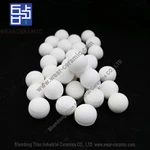
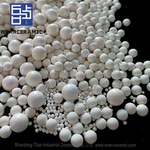


Balanced 3.2 Density Alumina Grinding Balls For Mineral Processing
1. Product Overview
Standard density 3.2 alumina grinding balls are monolithic sintered spherical ceramics developed for medium-load pulverizing workflows. Differing from lighter low-gravity milling media and premium zirconia beads, this product adopts balanced alumina ingredients and rotary forming followed by precision high-temperature densification. Constant 3.2 density delivers appropriate impact and shear force during equipment rotation. Positioned in the mid-range of ceramic grinding consumables, it addresses market demands between entry-level lightweight media and high-density milling beads, ideal for vertical grinding machines and medium-scale ball mill production for material refinement.
2. FABE & EEAT Analysis
F – Core Product Features
Well-proportioned alumina composition fired by staged heating technology to sustain stable 3.2 density
Superior roundness minimizes irregular collisions and supports uniform shearing action on raw materials
Moderate hardness brings gradual wear performance and reduces frequent media replenishment work
Chemically stable ceramic matrix restrains substance precipitation, preserving the purity of light-hued mineral powder
Complete range of particle sizes enables flexible grading schemes for varied pulverizing technical requirementsDensity, spherical accuracy and abrasion indicators are verified by independent material testing laboratories. Traceable batch inspection paperwork can be provided upon each shipment.
A – Unique Competitive Advantages
Low-density grinding beads come with competitive pricing yet generate insufficient pulverizing power, extending batch processing duration for medium-fine grinding tasks. Zirconia milling beads achieve outstanding fineness but carry high procurement costs, bringing unnecessary financial pressure to regular production. Standard density 3.2 alumina grinding balls fill this performance gap. Reliable specific gravity accelerates pulverization cycles without excessive investment. Smooth spherical surfaces ease uneven abrasion to internal mill liners. When compared with high-density alternatives, it controls recurring production costs while satisfying target particle size standards.
B – Tangible Operational Benefits For Buyers
Ceramic raw material manufacturers and mineral deep-processing plants can raise overall grinding productivity using these alumina grinding balls. Adequate pulverizing force shortens single-batch operation time and lifts workshop throughput. Steady and mild wear extends service cycles, cutting downtime caused by media supplement and replacement. Contamination-free ceramic material protects the quality of kaolin, feldspar and quartz feedstock, lowering economic losses from defective batches. Multiple optional diameters allow technical staff to adjust grading ratios and maintain consistent finished material fineness.
E – EEAT Credibility Evidence
Our industrial ceramic plant owns fully automatic granulation and sintering production lines and holds valid ISO9001 certification. Our ceramic grinding media are exported to mineral processors across Southeast Asia and Central Asia, maintaining long-term cooperative ties with numerous continuous-production manufacturers. One feldspar refinery previously adopted low-density grinding beads and faced prolonged processing cycles. After switching to 3.2 density alumina grinding balls, single-batch working time decreased by approximately 18%, and media consumption volume declined evidently. Custom particle size combinations can be developed to match customers' existing grinding equipment.
3. Application Scenarios
This grinding media series adapts to medium-load continuous medium-fine pulverizing operations. Widely deployed inside vertical sand mills and medium-sized horizontal ball mills to process kaolin, feldspar, quartz and general ceramic clay. Suitable for mass production lines pursuing balanced efficiency and cost input, where ultra-fine pulverization standards are not mandatory yet stable processing quality remains essential.
4. CTA
Searching for well-balanced ceramic grinding media for medium-fine raw material pulverization? Reach our technical team to obtain abrasion test data, particle grading suggestions and factory direct bulk prices. Our material engineers formulate targeted media allocation schemes to boost grinding efficiency and control long-term manufacturing costs.
5. FAQ
Q: Which working scenarios suit 3.2 density alumina grinding balls?A: They are designed for medium-load medium-fine grinding of ceramic raw materials and non-metallic minerals within vertical sand mills and medium-sized ball mills.
Q: What differentiates them from 2.9 density alumina grinding balls?A: Higher specific gravity delivers stronger pulverizing power, shortens processing cycles and performs better for medium-fine grinding requirements.
Q: Will these grinding beads contaminate light-colored mineral slurry?A: Inert alumina ceramic construction avoids ion leaching and prevents discoloration and purity degradation of light raw materials.
Q: Can special particle sizes be customized for unique pulverizing techniques?A: We adjust bead diameters and offer grading recommendations based on your equipment specifications and production parameters.
Q: What is the delivery timeline for bulk orders of standard specifications?A: Regular sizes maintain inventory; bulk shipments will be arranged within 7–15 working days once deposit is confirmed.
Hot Tags: balanced 3.2 density alumina grinding balls for mineral processing, manufacturers, suppliers, factory, price, made in China, Alumina Ceramic Grinding Beads, alumina ceramic material, Alumina grinding media balls, aluminum oxide alumina ceramic, inert ceramic, milling ceramics
Previous
No InformationYou Might Also Like


Send Inquiry